Tuesday, 27 January 2015
Why can't the search engines figure out my site without SEO?
Why need website SEO?

In battle against Islamic State, Iraqi tribal chiefs plead for more U.S. aid

Thursday, 2 January 2014
BNP seeks Speaker's intervention
BNP MPs have sought the Speaker's intervention, claiming that the Leader of the Opposition is being kept
A BNP parliamentary party delegation has met Speaker Shirin Sharmin Chaudhury at her office on Thursday morning, handing her a memorandum.
Opposition chief whip Joynul Abdin Farroque read out its contents at a media briefing after their 10-minute meeting with the Speaker.
"We sought the Speaker's intervention. She has assured us that she will speak to the Home Ministry on the matter," he said.
He said that the Ninth Parliament was still in force and Khaleda Zia was still the Leader of the Opposition.

The BNP MP said that the nation wanted to know why Khaleda had been confined to her home and was not being allowed to meet party leaders while her 'protocols' had also been withdrawn.
BNP lawmakers have also sought an appointment with President Md Abdul Hamid to discuss the matter, Farroque told bdnews24.com just after the meeting with the Speaker.
He said that the Bangabhaban will inform them in the afternoon when the President will meet them.
The 18-party opposition alliance led by the BNP is enforcing a non-stop road, rail and waterways blockade from Jan 1 after failing to hold its 'march to Dhaka' and Naya Paltan rally on Sunday (Dec 29).
Khaleda was unable to leave her Gulshan residence for Naya Paltan, as the police had boxed her in.
The BNP says its Chairperson has been 'effectively under house arrest' though the government denies the allegation.
A BNP parliamentary party delegation has met Speaker Shirin Sharmin Chaudhury at her office on Thursday morning, handing her a memorandum.
Opposition chief whip Joynul Abdin Farroque read out its contents at a media briefing after their 10-minute meeting with the Speaker.
"We sought the Speaker's intervention. She has assured us that she will speak to the Home Ministry on the matter," he said.
He said that the Ninth Parliament was still in force and Khaleda Zia was still the Leader of the Opposition.
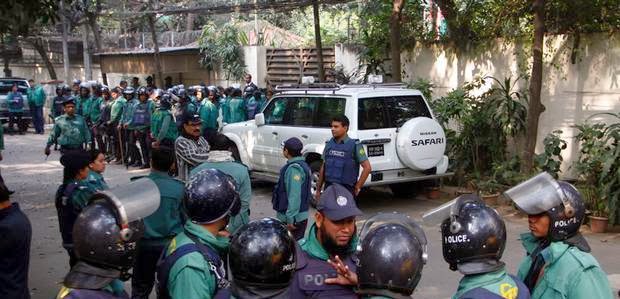
The BNP MP said that the nation wanted to know why Khaleda had been confined to her home and was not being allowed to meet party leaders while her 'protocols' had also been withdrawn.
BNP lawmakers have also sought an appointment with President Md Abdul Hamid to discuss the matter, Farroque told bdnews24.com just after the meeting with the Speaker.
He said that the Bangabhaban will inform them in the afternoon when the President will meet them.
The 18-party opposition alliance led by the BNP is enforcing a non-stop road, rail and waterways blockade from Jan 1 after failing to hold its 'march to Dhaka' and Naya Paltan rally on Sunday (Dec 29).
Khaleda was unable to leave her Gulshan residence for Naya Paltan, as the police had boxed her in.
The BNP says its Chairperson has been 'effectively under house arrest' though the government denies the allegation.
Jatiya Party releases manifesto
The Jatiya Party has released its manifesto for the 10th parliamentary election ending speculation about the party’s participation in the general election.
For weeks, its leaders had issued conflicting statements creating smokescreen arourd the party’s real plans.
Presidium Member Anisul Islam Mahmud launched the document at Hotel Sonargaon on Thursday.
He said party Chairman HM Ershad had helped prepare the manifesto while his wife and senior Presidium Member Raushan Ershad had directed him to release it.

Presidium members Kazi Firoz Rashid, Tajul Islam and Nasim Osman were present at the function.
When asked why he, instead of the party chairman or the secretary general, released the manifesto, Anisul said the chairman was in the Combined Military Hospital, while the secretary general was busy campaigning.
Raushan Ershad could not attend the programme on health grounds, he said.
Anisul said the Jatiya Party was in the election and the nominated candidates would take part in it with party symbol, the ‘plough’.
On whether Ershad was informed about the release of the manifesto, he said: “Each word of the manifesto has been dictated by him.”
The party has eight pledges – the first being upholding of Islamic values.
Jatiya Party Chairman HM Ershad announced his boycott of the elections a day after the party candidates submitted their nominations.
The party leaders made various statements on joining the polls since then.
Ershad was admitted to the Combined Military Hospital amid the escort of RAB on Dec 12.
The ruling Awami League allotted 60 seats for the Jatiya Party while finalising seat distribution.
For weeks, its leaders had issued conflicting statements creating smokescreen arourd the party’s real plans.
Presidium Member Anisul Islam Mahmud launched the document at Hotel Sonargaon on Thursday.
He said party Chairman HM Ershad had helped prepare the manifesto while his wife and senior Presidium Member Raushan Ershad had directed him to release it.

Presidium members Kazi Firoz Rashid, Tajul Islam and Nasim Osman were present at the function.
When asked why he, instead of the party chairman or the secretary general, released the manifesto, Anisul said the chairman was in the Combined Military Hospital, while the secretary general was busy campaigning.
Raushan Ershad could not attend the programme on health grounds, he said.
Anisul said the Jatiya Party was in the election and the nominated candidates would take part in it with party symbol, the ‘plough’.
On whether Ershad was informed about the release of the manifesto, he said: “Each word of the manifesto has been dictated by him.”
The party has eight pledges – the first being upholding of Islamic values.
Jatiya Party Chairman HM Ershad announced his boycott of the elections a day after the party candidates submitted their nominations.
The party leaders made various statements on joining the polls since then.
Ershad was admitted to the Combined Military Hospital amid the escort of RAB on Dec 12.
The ruling Awami League allotted 60 seats for the Jatiya Party while finalising seat distribution.
Hasina to address the nation
Awami League chief and Prime Minister Sheikh Hasina will deliver her electoral speech on state radio, TV this evening.
Her press secretary Abul Kalam Azad said that the speech will be aired at 7pm on the state-owned BTV and Bangladesh Betar.

The speech is a part of the campaign in the run-up to Jan 5 polls through BTV for chiefs or representatives of the six political parties out of 12 going to polls.
Her press secretary Abul Kalam Azad said that the speech will be aired at 7pm on the state-owned BTV and Bangladesh Betar.
The speech is a part of the campaign in the run-up to Jan 5 polls through BTV for chiefs or representatives of the six political parties out of 12 going to polls.
Bomb haul from dustbin
More than 40 handmade bombs have been found abandoned in a dustbin in Dhaka's Mohammadpur on Thursday.
RAB-2 Commander KM Azad said 43 handmade bombs were found in a bag lying in a dustbin at Bijli Moholla.

"The bombs, made with in glass bottles with sulphur and potassium with pebbles as splinters, seems to be powerful," he told bdnews24.com.
Local shopkeeper Matiur Rahman said that a boy found the bombs while searching the dustbin for scrap papers.
"He informed one person about what had seen. Later, the RAB recovered them."
Six to seven bombs exploded at the adjacent Ring Road when mediapersons gathered at the spot on being informed about the recovery.
One person has been detained in connection with the explosions.
RAB-2 Commander KM Azad said 43 handmade bombs were found in a bag lying in a dustbin at Bijli Moholla.

"The bombs, made with in glass bottles with sulphur and potassium with pebbles as splinters, seems to be powerful," he told bdnews24.com.
Local shopkeeper Matiur Rahman said that a boy found the bombs while searching the dustbin for scrap papers.
"He informed one person about what had seen. Later, the RAB recovered them."
Six to seven bombs exploded at the adjacent Ring Road when mediapersons gathered at the spot on being informed about the recovery.
One person has been detained in connection with the explosions.
Wednesday, 1 January 2014
Mozena meets Shamsher Mobin
The US ambassador in Dhaka Dan W Mozena has met BNP Vice Chairman Shamser Mobin Chowdhury on Wednesday.
Mozena entered Chowdhury's Banani home at 11.30 am and left after an hour and half.
The BNP leader told bdnews24.com after the meeting: "The
US ambassador
just came to meet. We exchanged pleasantries."

He, however, did not clarify what else were the matters they
discussed.
Mozena had gone to the BNP chief's Gulshan residence on
Tuesday amid heavy police cordon. The meeting lasted for one and a half hour.
In a statement after the meeting the US
envoy said that the political parties need to engage in “serious dialogue” and
immediately find an “agreed” way to hold free, fair and credible elections.
He also conveyed the US
government’s concern at the recent wave of arrests of senior political leaders.
On Monday, British High Commissioner Robert Gibson had met
the Leader of the Opposition.
Shamsher Mobin Chowdhury was present in that meeting. Police
had arrested him as soon as he emerged from Khaleda's house but released him
hours later.
‘Notebooks for students in future’

Prime Minister Sheikh Hasina has pledged to give Notebooks
to all students in future so they can download books from the internet.
“We will give Notebooks (to students) that will have
everything. Digital books will also be given in the future,” she said, while
inaugurating a textbook festival at the Gana Bhaban on Wednesday.
She said there would not be any need to send books to remote
areas; students would be able to download books from the Internet.
Hasina gave textbooks to some students at the festival.
She congratulated those involved in book production for
completing their task in time despite the political violence in the country.
The Prime Minister said 38.6 million people in Bangladesh
were now using the Internet.
She said they were planning to make youths skilled in
outsourcing.
This year, 43,353,201 students will receive 317,725,526
textbooks and other education materials.
Schools across Bangladesh
will hold textbook festivals on Thursday to distribute books among students.
The government has been distributing free textbooks to
students since 2010.
As many as 1.24 billion books have been distributed in the
past four years.
Court rejects complaint against Khaleda

A Dhaka court has refused to admit a
complaint lodged against Opposition Leader Khaleda Zia, accusing her of issuing
threats during her altercation with police on Sunday
After a hearing on Wednesday, Dhaka Metropolitan Magistrate
Asaduzzaman Noor observed that it was not clear how the complainant, Bangladesh
freedom-fighter Awami League founder Mojibur Rahman Molla, was defamed by
Khaleda Zia’s comment.
Molla had filed the complaint on Wednesday morning accusing
the BNP chief of issuing threats during an altercation with police on Sunday.
Angry over the police refusal to let her leave her house to
attend a party rally, Khaleda warned a woman police official, apparently
hailing from Gopalganj, of changing the district's name which happens to be
Prime Minister Sheikh Hasina's home district.
“Where do you hail from? Gopali? Will change the name of
Gopalganj. It will not exist any longer,” she thundered.
The Opposition Leader was much criticised by Gopalganj residents
as well by Awami League leaders for the comments.
In his complaint Molla, who is also a resident of Gopalganj,
said that comment was defamatory and charged Khaleda for issuing threat and
instigation.
On Tuesday, the same court had refused to admit a similar
complaint against the BNP chief filed by one AB Siddique.
Friday, 5 July 2013
NBR freezes Ashraful’s bank accounts
The National Board of Revenue (NBR) has frozen the bank accounts of cricketer Mohammad Ashraful who is at the heart of a spot-fixing scandal in Bangladesh.
NBR’s Income Tax Policy Department member Syed Md Aminul Karim confirmed the revenue board’s action on Thursday.

The former Bangladesh captain is currently under suspension from all forms of the game for his involvement in spot-fixing in the second edition of the Bangladesh Premier League (BPL).
Aminul Karim said Bangladesh Bank has already asked all commercial banks to inform it about transactions taking place in the last two years in Ashraful’s accounts.
If the investigation finds any irregularities, Ashraful would be sued for evading tax and illegal transactions, he said.
Karim said accusations brought up against the cricketer might include tax dodge. “The probe is underway. The NBR has taken the step in line with the special provision of the Income Tax Ordinance.”
“The NBR has sought Ashraful’s revenue-related documents. He might face questioning if any irregularities are found.”
Ashraful’s legal income is Tk 15 million a year, but the revenue board suspects it is much higher.
The NBR also suspects he has bank accounts abroad and he bought lands using a different name.
Bangladesh Cricket Board (BCB) pays the cricketers through the Standard Chartered Bank.
However, Ashraful told reporters that the NBR did not inform him about anything before declining further comment.
NBR’s Income Tax Policy Department member Syed Md Aminul Karim confirmed the revenue board’s action on Thursday.
The former Bangladesh captain is currently under suspension from all forms of the game for his involvement in spot-fixing in the second edition of the Bangladesh Premier League (BPL).
Aminul Karim said Bangladesh Bank has already asked all commercial banks to inform it about transactions taking place in the last two years in Ashraful’s accounts.
If the investigation finds any irregularities, Ashraful would be sued for evading tax and illegal transactions, he said.
Karim said accusations brought up against the cricketer might include tax dodge. “The probe is underway. The NBR has taken the step in line with the special provision of the Income Tax Ordinance.”
“The NBR has sought Ashraful’s revenue-related documents. He might face questioning if any irregularities are found.”
Ashraful’s legal income is Tk 15 million a year, but the revenue board suspects it is much higher.
The NBR also suspects he has bank accounts abroad and he bought lands using a different name.
Bangladesh Cricket Board (BCB) pays the cricketers through the Standard Chartered Bank.
However, Ashraful told reporters that the NBR did not inform him about anything before declining further comment.
11 missing as cargo ship ‘sinks’ off Phuket

The crewmen went missing after MV Hope ‘sank’ off the coast of Phuket early on Thursday amid hostile weather, Thai media had reported earlier.
MV Hope’s registering authority, Mercantile Marine Department’s Principal Officer Shafiqul Islam said the cargo vessel ran into massive waves and stiff crosswinds in the Andaman Sea.
He said the ship was returning with 6,545 metric tonnes of ball clay used in the ceramics industry after picking it up from Lumut port in Malaysia. “We were told that 11 of the 17-member crew of the ship are still missing. Six others were rescued.”
Thai news agency "Phuket News" said the Royal Thai Navy was conducting the rescue operations at the spot of capsize, about 29 nautical miles (54 kilometres) south of Racha Yai Island.
According to the vessel’s owners, the missing crew members were the ship’s Captain Rajib Chandra Karmakar, Chief Officer Md Mahbub Morshed, Second Officer Mobarak Hossain, Deck Cadet ‘Faizur’, Chief Engineer Kazi Saifuddin, Second Engineer Md Nejam Uddin, Engine Cadet Mushfiqur Rahman, Electricians Chhadim Ali, KB Nasir Uddin and Ali Hossain and Chief Cook Nasir Uddin.
MV Hope’s Fourth Engineer Md Abdul Hakim, Deck Cadets Mokhlesur Rahman, Abu Bakar Siddique, Md Rubel, Md Osman and Saiful Islam were rescued from the sea.
Five of them were spotted in a lifeboat and were later picked up by a German container ship Buxmoon, which will take them to Bangladesh. They are believed to be fine.
Abu Bakar, 40, was pulled out of the sea injured and was flown aboard a Thai Navy helicopter to Phuket, where he is now recovering in Vachira Phuket Hospital, the “Nation” online said.
"Phuket News" said search for the unaccounted-for crew was going on. Rescued crew members said they did get off the sinking ship in life boats but efforts to trace them drawn blank.
Islam said the 23-year old MV Hope was owned by Trade Bridge Shipping Ltd.
Sama Quader Chowdhury is the owner of Trade Bridge Shipping Ltd. She is also the wife of Jamal Uddin Quader Chowdhury, brother of BNP leader Salauddin Quader Chowdhury.
The ship’s certificate showed its load-carrying capacity was 5,550 metric tonnes. But according to the information provided to Chittagong Port Authority by the owners, it showed the ship was carrying nearly 1,000 metric tonnes more than its capacity.
Shafiqul Islam said the ship was supposed to return to Chittagong port on July 8.
In the early morning light, the MV Hope lists heavily in stormy seas. Photo: Royal Thai Navy
Abu Bakar Siddique receives a visit from Marine Police in Vachira Hospital. Photo: The Phuket News
However, the reason for the capsize is not yet clear, but the 97-metre, 5,550-ton MV Hope broadcast an SOS at 3:57am Thursday which was picked up by the Australian Rescue Coordination Centre (RCC), "Phuket News" said.
Australian RCC relayed details of the ship’s last known position to its counterpart in Bangkok.
Heading northwest, it had run into heavy crosswinds and waves coming beam-on, "Phuket News" added.
A Royal Thai Navy Third Fleet helicopter was scrambled soon after that and flew out to check the spot of capsize.
A navy helicopter and patrol plane were also circling the area, looking for the missing crew members.
Final preparations for Gazipur poll
Election Commission on Friday started the final preparations for the maiden Gazipur City Corporation elections by sending poll materials to voting stations.
Returning Official Matiar Rahman said the commission started distributing ballots, boxes and other materials from four centre
 s of Nagar Bhaban, Returning Officer’s office and National University at 12 noon.
Presiding Officers were taking ballot boxes, ballot papers, pad, permanent ink and other relevant materials to their respective stations, bdnews24.com Correspondent reported from the scene.
A total of 1,026,938 voters – 527,777 males and 499,161 females – will exercise their franchise in 392 polling stations on Saturday to elect their first Mayor. Voting will take place from 8:00am to 4:00pm.
The eleventh City Corporation of the country was formed in January this year, comprising Tongi and Gazipur municipality, with an area of almost 330 square kilometres.
Over 11,000 law enforcers are expected to ensure peaceful voting.
There are 57 general wards and 19 reserved for women in this city.
A total of six candidates will be competing for the post of Mayor. The prime contest is expected between Awami League-backed Azmat Ullah Khan and opposition-supported MA Mannan.
Returning Official Matiar Rahman said the commission started distributing ballots, boxes and other materials from four centre
Presiding Officers were taking ballot boxes, ballot papers, pad, permanent ink and other relevant materials to their respective stations, bdnews24.com Correspondent reported from the scene.
A total of 1,026,938 voters – 527,777 males and 499,161 females – will exercise their franchise in 392 polling stations on Saturday to elect their first Mayor. Voting will take place from 8:00am to 4:00pm.
The eleventh City Corporation of the country was formed in January this year, comprising Tongi and Gazipur municipality, with an area of almost 330 square kilometres.
Over 11,000 law enforcers are expected to ensure peaceful voting.
There are 57 general wards and 19 reserved for women in this city.
A total of six candidates will be competing for the post of Mayor. The prime contest is expected between Awami League-backed Azmat Ullah Khan and opposition-supported MA Mannan.
CNG strike called off, magistrate suspended
The nationwide CNG-refuelling-station strike called off around midday on Friday after an Executive Magistrate of a mobile court Abdul Hai, against whom refuelling station owners called the strike, was suspended.
Petrol Pump and CNG Filling Station Owners’
 Association Executive Committee member Abdullah Al Mamun told bdnews24.com that they called off the strike after a meeting with Prime Minister’s Energy Advisor, Energy Secretary and Petrobangla Chairman.
“They have assured to fulfil our demands. We have agreed to withdraw our strike.”
A nationwide strike was in effect from 6:00am alleging ‘harassment’ and ‘illegal fines’ of mobile courts.
The owners accused the magistrate of extorting and harassing one of their members in Sylhet. The Magistrate had allegedly demanded Tk 500,000 as bribe from a Sylhet CNG station.
Sylhet Deputy Commissioner Shahidul Islam confirmed the suspension to bdnews24.com on Friday morning.
The suspension order was issued after refueling stations across the country went on a strike from Friday morning in solidarity with its unit in Sylhet, where CNG filling stations had been closed since Thursday afternoon.
Petrol Pump and CNG Filling Station Owners’
“They have assured to fulfil our demands. We have agreed to withdraw our strike.”
A nationwide strike was in effect from 6:00am alleging ‘harassment’ and ‘illegal fines’ of mobile courts.
The owners accused the magistrate of extorting and harassing one of their members in Sylhet. The Magistrate had allegedly demanded Tk 500,000 as bribe from a Sylhet CNG station.
Sylhet Deputy Commissioner Shahidul Islam confirmed the suspension to bdnews24.com on Friday morning.
The suspension order was issued after refueling stations across the country went on a strike from Friday morning in solidarity with its unit in Sylhet, where CNG filling stations had been closed since Thursday afternoon.
3 more Bangladeshis missing

Ship owners’ P&I Club representative Captain Mahiuddin Abdul Kader said the Thai flag MV Pilin was headed for Chittagong port.
Though he said that a Bangladeshi had recently bought the vessel, he could not mention the name.
The trawler departed from Thailand on Jul 3. On the way, it encountered bad weather. “Thai authorities said that the 11 sailors were missing since then.”
According to Abdul Kader, the Captain of the vessel was Kripayan Chakma from Khagrachhari. “There are two other Bangladeshis.”
However, he could not tell their names.
A Bangladeshi cargo ship MV Hope tilted to its side due to rough weather on Thursday with 17 sailors on board.
Though six sailors were rescued, 11 others remained missing until last updates on Friday afternoon.
Friday, 28 June 2013
Shibir calls hartal for Sunday if leaders not released by Saturday
Islami Chhatra Shibir on Friday threatened to enforce a nationwide daylong hartal on Sunday if its arrested leaders and activists are not released and missing ones are not traced by Saturday.

Shibir, the associate student wing of Bangladesh Jamaat-e-Islami, will stage demonstrations across the country on Saturday to press home the demands and protesting the killing of its men by ‘ruling party men’.
“We will be compelled to enforce the hartal on Sunday if our demands aren’t met by Saturday,” Shibir secretary general Abdul Jabbar said in a statement.
Shibir, the associate student wing of Bangladesh Jamaat-e-Islami, will stage demonstrations across the country on Saturday to press home the demands and protesting the killing of its men by ‘ruling party men’.
“We will be compelled to enforce the hartal on Sunday if our demands aren’t met by Saturday,” Shibir secretary general Abdul Jabbar said in a statement.
Central BNP leaders throng to Gazipur for winning
Buoyed by their successes in the recently-held four city polls, opposition BNP has formed 57 committees, one in each ward, comprising central leaders, to carry out strong electioneering in Gazipur City Corporation to help their party-backed mayoral candidate MA Mannan come out winner in its polls slated for July 6.
BNP vice chairmen, joint secretaries general, organising secretaries and other central leaders are leading the teams while BNP standing committee member ASM Hannan Shah is coordinating and monitoring the overall election campaign, Gazipur unit BNP president Fazlul Haque Milon told reporters.
 Besides, BNP standing committee members and top leaders of the party’s associate bodies will also be there on the field to make sure the alliance-backed candidates, including councillors, come out winners in the election.
Milon said the 57 teams that started electioneering on Thursday are distributing leaflets, carrying out mass contacts and gearing up spirit of the party men and making people aware of election manipulation and persuading them to vote for the party-backed candidates.
In their electioneering, he said, they were mainly highlighting the government’s misrule, misdeeds, corruption, repressive acts, failures to develop Gazipur and Mannan’s 11-point election manifesto to woo the voters.
Bringing allegations that the local administration is harassing their supporters and trying to influence the elections in favour of the ruling alliance-supported candidate Ajmat Ullah Khan, Milon said they have also information that the ruling party men are preparing to manipulate the polls through intimidating the voters and flexing their muscle.
Contacted, BNP standing committee member Khandaker Mosharraf Hossain said the ruling party is making various plots to take results in their favour, but the people of Gazipur will resist their all evil designs and reject them as people in four other cities did.
Asked about his party’s strategies for the polls, the BNP leader said they have already made the government nervous enough by defeating the ruling party-blessed candidates in the four city polls. “Now we’re closely monitoring their activities and will devise our plans on their mistakes. The more the ruling party will be desperate the more they will make mistakes and we will capitalise on that.”
He said Awami League has given them apparently a walkover by forcing their rebel candidate Jahangir Alam to stay off the polls. “It’s their great mistake to pull Jahangir out of the polls which makes our victory very easier.”
Justifying his claim, Mosharraf said regional factor is very important in local body polls. Ajmat is a candidate from Tongi which has only three lakh voters while Mannan and Jahangir are from Gazipur where there are over seven lakh voters. “The people of Gazipur usually don’t want to elect a man of Tongi as their mayor.”
He also thinks that the supporters of Jahangir will not vote for Ajmat as the ruling party forced him to quit the race using state power.
“I’ll surely win by at least a margin of two lakh votes if people can freely exercise their franchise,” MA Mannan told reporters on Friday noon.
Demanding deployment of Army for ensuring fair polls, the opposition-backed mayoral runner said people have the apprehension that the government might try to rig the vote. “Voters have got panicked as the ruling party cadres picked up Jahangir from Gazipur, took him to Dhaka and then forced him to quit the race.”
Mannan, however, hoped that people with their all strength will resist any move to manipulate the polls.
He said people will cast their votes for him in protest against the government’s all-pervasive corruption, anti-Islam stance, repression and oppression on people.
BNP vice chairmen, joint secretaries general, organising secretaries and other central leaders are leading the teams while BNP standing committee member ASM Hannan Shah is coordinating and monitoring the overall election campaign, Gazipur unit BNP president Fazlul Haque Milon told reporters.
Milon said the 57 teams that started electioneering on Thursday are distributing leaflets, carrying out mass contacts and gearing up spirit of the party men and making people aware of election manipulation and persuading them to vote for the party-backed candidates.
In their electioneering, he said, they were mainly highlighting the government’s misrule, misdeeds, corruption, repressive acts, failures to develop Gazipur and Mannan’s 11-point election manifesto to woo the voters.
Bringing allegations that the local administration is harassing their supporters and trying to influence the elections in favour of the ruling alliance-supported candidate Ajmat Ullah Khan, Milon said they have also information that the ruling party men are preparing to manipulate the polls through intimidating the voters and flexing their muscle.
Contacted, BNP standing committee member Khandaker Mosharraf Hossain said the ruling party is making various plots to take results in their favour, but the people of Gazipur will resist their all evil designs and reject them as people in four other cities did.
Asked about his party’s strategies for the polls, the BNP leader said they have already made the government nervous enough by defeating the ruling party-blessed candidates in the four city polls. “Now we’re closely monitoring their activities and will devise our plans on their mistakes. The more the ruling party will be desperate the more they will make mistakes and we will capitalise on that.”
He said Awami League has given them apparently a walkover by forcing their rebel candidate Jahangir Alam to stay off the polls. “It’s their great mistake to pull Jahangir out of the polls which makes our victory very easier.”
Justifying his claim, Mosharraf said regional factor is very important in local body polls. Ajmat is a candidate from Tongi which has only three lakh voters while Mannan and Jahangir are from Gazipur where there are over seven lakh voters. “The people of Gazipur usually don’t want to elect a man of Tongi as their mayor.”
He also thinks that the supporters of Jahangir will not vote for Ajmat as the ruling party forced him to quit the race using state power.
“I’ll surely win by at least a margin of two lakh votes if people can freely exercise their franchise,” MA Mannan told reporters on Friday noon.
Demanding deployment of Army for ensuring fair polls, the opposition-backed mayoral runner said people have the apprehension that the government might try to rig the vote. “Voters have got panicked as the ruling party cadres picked up Jahangir from Gazipur, took him to Dhaka and then forced him to quit the race.”
Mannan, however, hoped that people with their all strength will resist any move to manipulate the polls.
He said people will cast their votes for him in protest against the government’s all-pervasive corruption, anti-Islam stance, repression and oppression on people.
Case filed against Sheikh Hasina, 25 others in ICC
A case against Sheikh Hasina, the Prime Minister of Bangladesh and 25 others has been filed in the International Criminal Court (ICC) for their allegedly involvement in crimes against humanity in Bangladesh.
Martin F. McMahon & Associates on behalf of the two organizations named Human Rights and Development for Bangladesh and Bangladeshi-Americans
 in Greater Washington DC has lodge the case in ICC on Thursday.
The case implicates members of the Bangladesh government and state security in crimes against humanity, petitioning the ICC to investigate and prosecute those responsible.
The allegations were cited including torture, forced disappearance, extrajudicial executions and mass murder. Cases include that of Mahmudur Rahman, reported by Amnesty; police abduction of Shukhoranjan Bali, a defense witness of the controversial and discredited International Crimes Tribunal (ICT), reported by Human Rights Watch and abduction and execution of Aminul Islam, a labour rights organizer, reported by Amnesty.
Mass murder cases include the massacre of at least dozens of pro-Sayedee protesters by police on February 28, 2013 following the conviction of opposition leader and religious scholar Delwar Hossain Sayedee.
The massacre of Hefazat-e-Islam protesters, an apolitical religious group, by armed police and paramilitary during Hefazat’s sit-in in Dhaka on May 5 and 6 was cited in the filed case.
The submission implicates leaders, including the Prime Minister and Home Minister, and those directly participant in violations including Dhaka Metropolitan Police Commissioner Benazir Ahmed, Mehdi Hasan of Dhaka Police Motijhil district and Pradip Das of Chittagong Patchlaish Police Station.
Here is the list of those who were allegedly committed crimes against humanity in Bangladeshas demonstrated in the ICC filing:
The case bisects the level of crimes into two parts as Superior Command Responsibility and Direct Responsibility.
Those leveled as Superior Command Responsibility are as follows: Sheikh Hasina Wajed the Prime Minister Bangladesh, M. K. Alamgir the Minister Home Affairs, Hasanul Haq Inu the Minister Information Affairs, Shamsul Haq Tuku the State Minister Home Affairs, Kamrul Islam the State Minister Law and Parliament, Mahbubul Alam Hanif the Joint Secretary General Bangladesh Awami League, Hassan Mahmud Khandakar the Inspector General Bangladesh Police, Mokhlesur Rahman the Director General Rapid Action Battalion, Aziz Ahmed the Director General Border Guard Bangladesh.
Those leveled as Direct Responsibility are as follows:
Benazir Ahmed the Commissioner Dhaka Metropolitan Police, Prodip Kumar the OC of Patchlaish Police Station, Mehdi Hassan the ADC of Motijhil Zone DMP, Harun-ur-Rashid the DC of Lalbagh Division DMP, Salauddin the OC of Mirpur Model Thana, Moshiur Rahman the ADC of Detective Branch, Khalillur Rahman the OC of Darus Salam, Adbul Latif the OC of Kafrul Thana, Ashik the Sub Inspector of Karful Thana, Rafikul Islam the OC of Jatrabari Thana, Asaduzzaman Nur the Metropolitan Magistrate, Shahidul Islam the Metropolitan Magistrate, M. Mustafizur Rahman the Metropolitan Magistrate, Harunur Rashid the Metropolitan Magistrate, Sajjadul Haq Shihab the Public Prosecutor.
Martin F. McMahon & Associates on behalf of the two organizations named Human Rights and Development for Bangladesh and Bangladeshi-Americans
The case implicates members of the Bangladesh government and state security in crimes against humanity, petitioning the ICC to investigate and prosecute those responsible.
The allegations were cited including torture, forced disappearance, extrajudicial executions and mass murder. Cases include that of Mahmudur Rahman, reported by Amnesty; police abduction of Shukhoranjan Bali, a defense witness of the controversial and discredited International Crimes Tribunal (ICT), reported by Human Rights Watch and abduction and execution of Aminul Islam, a labour rights organizer, reported by Amnesty.
Mass murder cases include the massacre of at least dozens of pro-Sayedee protesters by police on February 28, 2013 following the conviction of opposition leader and religious scholar Delwar Hossain Sayedee.
The massacre of Hefazat-e-Islam protesters, an apolitical religious group, by armed police and paramilitary during Hefazat’s sit-in in Dhaka on May 5 and 6 was cited in the filed case.
The submission implicates leaders, including the Prime Minister and Home Minister, and those directly participant in violations including Dhaka Metropolitan Police Commissioner Benazir Ahmed, Mehdi Hasan of Dhaka Police Motijhil district and Pradip Das of Chittagong Patchlaish Police Station.
Here is the list of those who were allegedly committed crimes against humanity in Bangladeshas demonstrated in the ICC filing:
The case bisects the level of crimes into two parts as Superior Command Responsibility and Direct Responsibility.
Those leveled as Superior Command Responsibility are as follows: Sheikh Hasina Wajed the Prime Minister Bangladesh, M. K. Alamgir the Minister Home Affairs, Hasanul Haq Inu the Minister Information Affairs, Shamsul Haq Tuku the State Minister Home Affairs, Kamrul Islam the State Minister Law and Parliament, Mahbubul Alam Hanif the Joint Secretary General Bangladesh Awami League, Hassan Mahmud Khandakar the Inspector General Bangladesh Police, Mokhlesur Rahman the Director General Rapid Action Battalion, Aziz Ahmed the Director General Border Guard Bangladesh.
Those leveled as Direct Responsibility are as follows:
Benazir Ahmed the Commissioner Dhaka Metropolitan Police, Prodip Kumar the OC of Patchlaish Police Station, Mehdi Hassan the ADC of Motijhil Zone DMP, Harun-ur-Rashid the DC of Lalbagh Division DMP, Salauddin the OC of Mirpur Model Thana, Moshiur Rahman the ADC of Detective Branch, Khalillur Rahman the OC of Darus Salam, Adbul Latif the OC of Kafrul Thana, Ashik the Sub Inspector of Karful Thana, Rafikul Islam the OC of Jatrabari Thana, Asaduzzaman Nur the Metropolitan Magistrate, Shahidul Islam the Metropolitan Magistrate, M. Mustafizur Rahman the Metropolitan Magistrate, Harunur Rashid the Metropolitan Magistrate, Sajjadul Haq Shihab the Public Prosecutor.
Egypt violence builds, American among dead
Two people, one an American, were killed when protesters stormed an office of Egypt's ruling Muslim Brotherhood in Alexandria, adding to growing tension ahead of mass rallies aimed at unseating the Islamist president.
A third man was killed and 10 injured in an explosion during a protest in Port Said, at the mouth of the Suez Canal. Police on Saturday said the cause was unclear but protesters, believing it was a bomb, attacked an Islamist party office in the city.
Egypt's leading religious authority warned of "civil war" after violence in the past week that had already left several dead and hundreds injured. They backed President Mohamed Mursi's offer to talk to opposition groups ahead of Sunday's protests.
 The United Nations, European Union and United States have appealed for restraint and urged Egypt's deadlocked political leaders to step back from a confrontation threatening the new democracy that emerged from the Arab Spring revolution of 2011.
The US embassy said in a statement it was evacuating non-essential staff and family members and renewed a warning to Americans not to travel to Egypt unless they had to.
The Muslim Brotherhood said eight of its offices had been attacked on Friday, including the one in Alexandria. Officials said more than 70 people had been injured in the clashes in the city. One was shot dead and a young American man who was using a small camera died after being stabbed in the chest.
A Brotherhood member was also killed overnight in an attack on a party office at Zagazig, in the heavily populated Nile Delta, where much of the recent violence has been concentrated. Mursi's movement said five supporters in all had died this week.
"Vigilance is required to ensure we do not slide into civil war," said clerics at Cairo's ancient Al-Azhar institute, one of the most influential centers of scholarship in the Muslim world.
In a statement broadly supportive of Mursi, they backed his offer of dialogue and blamed "criminal gangs" who besieged mosques for the violence. The Brotherhood warned of "dire consequences" and "a violent spiral of anarchy".
It accused liberal leaders, including former UN diplomat Mohamed ElBaradei, of personally inciting violence by hired "thugs" once loyal to ousted dictator Hosni Mubarak.
Opposition leaders condemned the violence. The army, which has warned it could intervene if political leaders lose control, issued a statement saying it had deployed across the country to protect citizens and installations of national importance.
In the capital, Cairo, tens of thousands turned out for rival events some miles apart and there was little trouble. An Islamist rally included calls to reconciliation. On Tahrir Square, cradle of the uprising against Mubarak, there was a festive atmosphere and a determination to shake Mursi on Sunday.
In Alexandria, as several thousand anti-Mursi protesters marched along the seafront, a Reuters reporter saw about a dozen men throw rocks at guards outside the Brotherhood office. They responded. Bricks and bottles flew. Guns were fired.
Officials said dozens were wounded by birdshot. The party office was ransacked and documents were burned, watched by jubilant youths chanting against Egypt's Islamist leaders.
In Port Said, a bastion of anti-Islamist sentiment, police had suspected an accident but later said a device exploded among protesters. Canal traffic has not been affected by violence.
CAIRO CALM
Islamists gathered round a Cairo mosque after weekly prayers to show support for Mursi. His opponents hope millions will turn out on Sunday to demand he step down, a year to the day after he was sworn in as Egypt's first freely chosen leader.
Mursi, backed by the Brotherhood, has dismissed such demands as an assault on democracy, setting up an angry confrontation.
"I came to support the legitimate order," said Ahmed al-Maghrabi, 37, a shopkeeper from the Nile Delta city of Mansoura whose hand bore grazes from street fighting there this week. "I am with the elected president. He needs to see out his term."
Some speakers reflected fear and anger among Islamists that opponents aim to suppress them as Mubarak did. But there was also talk from the podium of the need for dialogue - a concern also of international powers worried by the bitter polarization.
A few hundred opposition protesters gathered outside the presidential palace, a focus for Sunday's rally. Mursi has moved elsewhere. Thousands turned out after dark in Tahrir Square, waving national flags and sampling street food.
Abdelhamid Nada, a 32-year-old accountant, had come from the provinces with eight friends to camp out "until Mursi goes". "The Muslim Brotherhood has no plan at all," he said, standing by his white tent. "They don't have any economic plan, they don't have any social plan, they don't have any political plan."
STRATEGIC IMPORTANCE
The army, which heeded mass protests in early 2011 to push Mubarak aside, has warned it will intervene again if there is violence, and to defend the "will of the people". Both sides believe that means the military may support their positions.
The United States, which funds Egypt's army as it did under Mubarak, has urged compromise and respect for election results. Egypt's 84 million people, control of Suez and its peace treaty with Israel all contribute to its global strategic importance.
UN chief Ban Ki-moon urged Egyptians to respect "universal principles of peaceful dialogue". European Union foreign policy chief Catherine Ashton called for peaceful protests, building trust and a "spirit of dialogue and tolerance".
In Alexandria, opposition marchers said they feared the Brotherhood was usurping the revolution to entrench its power and Islamic law. Others had economic grievances, among them huge lines for fuel caused by supply problems and panic buying.
"I've nothing to do with politics, but with the state we're in now, even a stone would cry out," said 42-year-old accountant Mohamed Abdel Latif. "There are no services, we can't find diesel or gasoline. We elected Mursi, but this is enough.
"Let him make way for someone else who can fix it."
It is hard to gauge how many may turn out on Sunday, but even those sympathetic to Islamic ideas are frustrated by the economic slump and many blame the government.
Previous protest movements since the fall of Mubarak have failed to gather momentum, however, among a population anxious for stability and fearful of further economic hardship.
A third man was killed and 10 injured in an explosion during a protest in Port Said, at the mouth of the Suez Canal. Police on Saturday said the cause was unclear but protesters, believing it was a bomb, attacked an Islamist party office in the city.
Egypt's leading religious authority warned of "civil war" after violence in the past week that had already left several dead and hundreds injured. They backed President Mohamed Mursi's offer to talk to opposition groups ahead of Sunday's protests.
The US embassy said in a statement it was evacuating non-essential staff and family members and renewed a warning to Americans not to travel to Egypt unless they had to.
The Muslim Brotherhood said eight of its offices had been attacked on Friday, including the one in Alexandria. Officials said more than 70 people had been injured in the clashes in the city. One was shot dead and a young American man who was using a small camera died after being stabbed in the chest.
A Brotherhood member was also killed overnight in an attack on a party office at Zagazig, in the heavily populated Nile Delta, where much of the recent violence has been concentrated. Mursi's movement said five supporters in all had died this week.
"Vigilance is required to ensure we do not slide into civil war," said clerics at Cairo's ancient Al-Azhar institute, one of the most influential centers of scholarship in the Muslim world.
In a statement broadly supportive of Mursi, they backed his offer of dialogue and blamed "criminal gangs" who besieged mosques for the violence. The Brotherhood warned of "dire consequences" and "a violent spiral of anarchy".
It accused liberal leaders, including former UN diplomat Mohamed ElBaradei, of personally inciting violence by hired "thugs" once loyal to ousted dictator Hosni Mubarak.
Opposition leaders condemned the violence. The army, which has warned it could intervene if political leaders lose control, issued a statement saying it had deployed across the country to protect citizens and installations of national importance.
In the capital, Cairo, tens of thousands turned out for rival events some miles apart and there was little trouble. An Islamist rally included calls to reconciliation. On Tahrir Square, cradle of the uprising against Mubarak, there was a festive atmosphere and a determination to shake Mursi on Sunday.
In Alexandria, as several thousand anti-Mursi protesters marched along the seafront, a Reuters reporter saw about a dozen men throw rocks at guards outside the Brotherhood office. They responded. Bricks and bottles flew. Guns were fired.
Officials said dozens were wounded by birdshot. The party office was ransacked and documents were burned, watched by jubilant youths chanting against Egypt's Islamist leaders.
In Port Said, a bastion of anti-Islamist sentiment, police had suspected an accident but later said a device exploded among protesters. Canal traffic has not been affected by violence.
CAIRO CALM
Islamists gathered round a Cairo mosque after weekly prayers to show support for Mursi. His opponents hope millions will turn out on Sunday to demand he step down, a year to the day after he was sworn in as Egypt's first freely chosen leader.
Mursi, backed by the Brotherhood, has dismissed such demands as an assault on democracy, setting up an angry confrontation.
"I came to support the legitimate order," said Ahmed al-Maghrabi, 37, a shopkeeper from the Nile Delta city of Mansoura whose hand bore grazes from street fighting there this week. "I am with the elected president. He needs to see out his term."
Some speakers reflected fear and anger among Islamists that opponents aim to suppress them as Mubarak did. But there was also talk from the podium of the need for dialogue - a concern also of international powers worried by the bitter polarization.
A few hundred opposition protesters gathered outside the presidential palace, a focus for Sunday's rally. Mursi has moved elsewhere. Thousands turned out after dark in Tahrir Square, waving national flags and sampling street food.
Abdelhamid Nada, a 32-year-old accountant, had come from the provinces with eight friends to camp out "until Mursi goes". "The Muslim Brotherhood has no plan at all," he said, standing by his white tent. "They don't have any economic plan, they don't have any social plan, they don't have any political plan."
STRATEGIC IMPORTANCE
The army, which heeded mass protests in early 2011 to push Mubarak aside, has warned it will intervene again if there is violence, and to defend the "will of the people". Both sides believe that means the military may support their positions.
The United States, which funds Egypt's army as it did under Mubarak, has urged compromise and respect for election results. Egypt's 84 million people, control of Suez and its peace treaty with Israel all contribute to its global strategic importance.
UN chief Ban Ki-moon urged Egyptians to respect "universal principles of peaceful dialogue". European Union foreign policy chief Catherine Ashton called for peaceful protests, building trust and a "spirit of dialogue and tolerance".
In Alexandria, opposition marchers said they feared the Brotherhood was usurping the revolution to entrench its power and Islamic law. Others had economic grievances, among them huge lines for fuel caused by supply problems and panic buying.
"I've nothing to do with politics, but with the state we're in now, even a stone would cry out," said 42-year-old accountant Mohamed Abdel Latif. "There are no services, we can't find diesel or gasoline. We elected Mursi, but this is enough.
"Let him make way for someone else who can fix it."
It is hard to gauge how many may turn out on Sunday, but even those sympathetic to Islamic ideas are frustrated by the economic slump and many blame the government.
Previous protest movements since the fall of Mubarak have failed to gather momentum, however, among a population anxious for stability and fearful of further economic hardship.
Workers’ bodies flay GSP suspension
The US decision to suspend the GSP facilities for Bangladesh will not help of workers, though the move was made to press the government into implementing their rights, ready-made garment workers’ bodies say.
They fear that similar steps by the European Union after the ‘tough’ US action would badly damage Bangladesh’s garment sector and hurt the industry’s 3.6 million workers.
 US President Barack Obama early on Friday (Bangladesh time) announced the suspension of the US preferential trade benefits for Bangladesh in a mostly symbolic response to dangerous conditions in the garment industry that have cost more than 1,200 lives over the past one year.
However, the US sanction does not directly affect Bangladesh's main export, multi-billion-dollar clothing to the United States, since garments are not eligible for duty cuts under the Generalized System of Preference, or the GSP programme.
However, justifying the decision, US ambassador in Dhaka Dan W Mozena on Friday said his country’s decision would serve as ‘the first step’ in ensuring that devastations like the Rana Plaza building collapse or the Tazreen factory fire never occur again in Bangladesh.
“It’s not cancellation, it’s suspension,” he said calling for actions to regain the facility.
Meanwhile, the US said Bangladesh might regain the facility if it could improve the working environment in the factories and implement the labour rights.
Bangladesh Textile Garment Workers Federation President Mahbubur Rahman Ismail told bdnews24.com: “They [US] are saying this was done for the sake of the workers. But this will not help them. Rather they could have pressured the government to ensure compliance in garment factories, international standard salary and the right to form trade unions.”
Ismail feared the US decision would affect the market in Europe.
Garment Owners-Workers Unity Forum President Moshrefa Mishu is seeing the GSP suspension as a ‘step against Bangladesh’s interest’.
Mishu told bdnews24.com: “This is cannot be supported. This is illogical.”
Dubbing the US position ‘immoral’, Mishu said, “Now, if Europe does the same, the entire industry will be endangered. In that case, over 10 million people directly and indirectly involved in this industry will be in trouble.”
However, the Bangladesh Garment and Industrial Workers Federation President Babul Akhtar feels that the government steps to improve the working environment and hike the pay after the Tazreen Fashions factory fire and Rana Plaza collapse were positive.
The US decision to suspend the GSP facility without considering the government moves were wrong, he said.
Babul said, “Most of the brands from Europe have signed a safety agreement named ‘Building and Fire Safety’, which is already being implemented.”
“I don’t think the suspension of GSP at this point will affect the European market,” he added.
Trade Union Federation President Shah Atiul Islam seemed to agree.
In 2012, Bangladesh was spared about $2 million in US duties on about $35 million worth of goods under GSP programme, but it paid about $732 million in US duties on $4.9 billion of clothing exports not covered by the programme.
According to the Export Promotion Bureau (EPB), Bangladesh exported goods worth over $24 billion in the 2011-12 fiscal year. Of the total, 21 percent ($5 billion) was exported to the US.
On the other hand, the EU imported roughly 9.2 billion euros ($12.13 billion) worth of commodities from Bangladesh last year, according to the EU's executive, the European Commission.
Meanwhile, the Ministry of Foreign Affairs in a press release on Friday responded to the US decision saying, “It cannot be more shocking for the garment factory workers of Bangladesh that the decision to suspend GSP comes at a time when the Government of Bangladesh has taken concrete and visible measures to improve factory safety and protect workers’ rights.”
The government termed the US move unfortunate and expected that the Obama administration to soon restore Bangladesh’s GSP status, a benefit an underdeveloped country was entitled to from the developed world as per the provisions of the World Trade Organization.
But the garment owners and businessmen involved in the $20 billion sector believe the US decision was a ‘political move’ intended to make Bangladesh toe its line.
However, a former President of the BGMEA has said that the door for talks was open as the government had recently approved the draft of the Trade and Investment Cooperation Forum Agreement (Ticfa).
They fear that similar steps by the European Union after the ‘tough’ US action would badly damage Bangladesh’s garment sector and hurt the industry’s 3.6 million workers.
However, the US sanction does not directly affect Bangladesh's main export, multi-billion-dollar clothing to the United States, since garments are not eligible for duty cuts under the Generalized System of Preference, or the GSP programme.
However, justifying the decision, US ambassador in Dhaka Dan W Mozena on Friday said his country’s decision would serve as ‘the first step’ in ensuring that devastations like the Rana Plaza building collapse or the Tazreen factory fire never occur again in Bangladesh.
“It’s not cancellation, it’s suspension,” he said calling for actions to regain the facility.
Meanwhile, the US said Bangladesh might regain the facility if it could improve the working environment in the factories and implement the labour rights.
Bangladesh Textile Garment Workers Federation President Mahbubur Rahman Ismail told bdnews24.com: “They [US] are saying this was done for the sake of the workers. But this will not help them. Rather they could have pressured the government to ensure compliance in garment factories, international standard salary and the right to form trade unions.”
Ismail feared the US decision would affect the market in Europe.
Garment Owners-Workers Unity Forum President Moshrefa Mishu is seeing the GSP suspension as a ‘step against Bangladesh’s interest’.
Mishu told bdnews24.com: “This is cannot be supported. This is illogical.”
Dubbing the US position ‘immoral’, Mishu said, “Now, if Europe does the same, the entire industry will be endangered. In that case, over 10 million people directly and indirectly involved in this industry will be in trouble.”
However, the Bangladesh Garment and Industrial Workers Federation President Babul Akhtar feels that the government steps to improve the working environment and hike the pay after the Tazreen Fashions factory fire and Rana Plaza collapse were positive.
The US decision to suspend the GSP facility without considering the government moves were wrong, he said.
Babul said, “Most of the brands from Europe have signed a safety agreement named ‘Building and Fire Safety’, which is already being implemented.”
“I don’t think the suspension of GSP at this point will affect the European market,” he added.
Trade Union Federation President Shah Atiul Islam seemed to agree.
In 2012, Bangladesh was spared about $2 million in US duties on about $35 million worth of goods under GSP programme, but it paid about $732 million in US duties on $4.9 billion of clothing exports not covered by the programme.
According to the Export Promotion Bureau (EPB), Bangladesh exported goods worth over $24 billion in the 2011-12 fiscal year. Of the total, 21 percent ($5 billion) was exported to the US.
On the other hand, the EU imported roughly 9.2 billion euros ($12.13 billion) worth of commodities from Bangladesh last year, according to the EU's executive, the European Commission.
Meanwhile, the Ministry of Foreign Affairs in a press release on Friday responded to the US decision saying, “It cannot be more shocking for the garment factory workers of Bangladesh that the decision to suspend GSP comes at a time when the Government of Bangladesh has taken concrete and visible measures to improve factory safety and protect workers’ rights.”
The government termed the US move unfortunate and expected that the Obama administration to soon restore Bangladesh’s GSP status, a benefit an underdeveloped country was entitled to from the developed world as per the provisions of the World Trade Organization.
But the garment owners and businessmen involved in the $20 billion sector believe the US decision was a ‘political move’ intended to make Bangladesh toe its line.
However, a former President of the BGMEA has said that the door for talks was open as the government had recently approved the draft of the Trade and Investment Cooperation Forum Agreement (Ticfa).


 Posts
Posts


